Short answerAir freight shipping moves cargo by aircraft, so most shipments arrive in days instead of the weeks ocean freight takes. It costs more per kilo, so it suits urgent, high-value, perishable or lightweight cargo best. Heavy, bulky shipments with flexible deadlines usually go cheaper by ocean.
Last updated: October 2026
What is air freight shipping?
Air freight shipping (also called air shipping or shipping by air) is the transport of goods by aircraft, either in the hold of passenger flights or on dedicated cargo planes. A freight forwarder such as Faster Freight books the space, prepares the paperwork, and coordinates pickup, customs clearance and delivery at both ends.
It is a small slice of world trade by weight but a large slice by value. IATA, the airline industry association, has long estimated that air cargo carries about 35% of the value of global trade while making up less than 1% by volume (IATA air cargo overview). The goods that fly tend to be high value, urgent or light.
Air freight vs air cargo: is there a difference?
In everyday use, no. Shippers, airlines and forwarders use the two terms interchangeably, along with "air shipping", "airfreight" and "air shipment". Strictly speaking, cargo usually means the goods themselves, while freight usually means the service of moving them.
What ships by air
Almost any legal cargo that fits the aircraft can go by air, but these categories use it most:
- Time-critical parts and components that would stop a production line if they were late.
- High-value goods such as electronics and instruments.
- Perishables such as fresh flowers, seafood and produce.
- Fashion, e-commerce and retail restocks with fixed launch or season dates.
- Samples, prototypes and documents sent in small volumes.
- Regulated items such as lithium batteries, chemicals and aerosols, which can fly only when declared, classified and packed to IATA dangerous goods rules.
- Oversized or heavy pieces on dedicated freighter aircraft, within size limits.
Mail, live animals, relief supplies and military cargo also travel by air.
Benefits of air freight shipping
The main benefit of shipping goods by air is speed.
1. Speed
Air is the fastest way to move goods between continents. Cargo jets cruise at roughly 900 km/h (about 560 mph), so a flight that crosses an ocean takes hours, not weeks.
2. Frequent, predictable schedules
Airlines publish schedules, and busy routes often have several departures a week, sometimes daily. If a booking misses its flight, the next one is usually much sooner than the next vessel sailing.
3. Global reach
Airlines serve far more airports than container lines serve ports, so air freight reaches inland cities and smaller markets that have no nearby seaport.
4. Lower risk of damage and loss
Air cargo is screened and handled in controlled airport facilities. Fewer days in transit means fewer chances for delay, damage or theft.
5. Lower inventory costs
Shorter lead times let you hold less safety stock, reorder in smaller batches and react faster to demand. For high-value goods, fewer days in transit also means less money tied up on the move.
6. Easy tracking
Every air shipment travels under an air waybill (AWB) number, and departures, arrivals and customs releases are easy to follow. Your forwarder can update you at each step, and you can check status on our shipment tracking page.
The trade-offs to weigh
- Higher cost per kilo. Air is usually several times more expensive per kilo than ocean, and the gap is widest for heavy, dense cargo.
- Size and weight limits. Pieces must fit through the aircraft door and onto pallets or containers known as ULDs. Very large or heavy items may need a freighter or another mode, such as heavy equipment shipping.
- Price swings. Fuel and security surcharges, and tight space before peak seasons, can change the price from one quote to the next.
- Dangerous-goods rules. Batteries, chemicals and aerosols can fly only when declared and packed to IATA rules, and some cannot travel on passenger aircraft.
- Weather and airport disruption. Delays still happen, especially on connecting routings.
- Emissions. Air freight produces more CO₂ per tonne-kilometre than ocean freight, which matters if you report on supply chain emissions.
When should you use air freight instead of ocean freight?
Choose air when the cost of arriving late, or of tying up inventory, is bigger than the extra freight.
| Factor | Air freight | Ocean freight |
|---|---|---|
| Typical transit | Days | Weeks |
| How it is priced | Chargeable weight (actual or volumetric, whichever is greater) | Per container (FCL) or per cubic meter (LCL) |
| Cost per kilo | Higher | Lower, especially for heavy or high-volume loads |
| Best for | Urgent, high-value, perishable, lightweight or low-volume cargo | Heavy, bulky, high-volume or non-urgent cargo |
| Size limits | Set by aircraft door and pallet or ULD dimensions | 20 ft and 40 ft containers, plus flat racks and open tops for oversized cargo |
| Departures | Frequent on busy routes | Fewer, often weekly |
| Emissions per tonne-km | Higher | Lower |
Time-sensitive and production-critical shipments
Air freight makes sense when lateness is expensive: a stopped production line, a missed product launch, an urgent spare part or a retail season with a fixed date. A fast flight only helps if the rest of the journey keeps pace, because slow pickup, missing paperwork or a customs hold can cancel out the time you paid for.
Follow these steps to keep an air shipment on schedule:
- Book early and confirm the airline's cut-off time for delivering cargo.
- Have the commercial invoice, packing list and any permits ready before pickup.
- Pack to the airline's size, weight and labeling requirements.
- Declare batteries, chemicals and other regulated items before you book.
- Ask for direct or one-stop routings on urgent cargo.
- Arrange customs clearance at the destination in advance.
More ideas are in our guide to 5 ways to optimize air freight shipments.
High-value goods
When goods are worth a lot compared with their weight, freight is a small share of the landed cost. Days saved also mean less money tied up in transit and less exposure to loss. Electronics and instruments are typical examples.
Perishable and temperature-sensitive cargo
Fresh flowers, seafood and produce have short shelf lives, so they are commonly flown. If your cargo has temperature requirements, say so when you ask for a quote so your forwarder can confirm what is possible on your route.
Light, low-volume and sample shipments
For samples, prototypes, printed materials and small replenishment orders, the cost gap against ocean LCL can be modest in absolute terms, while the time saved is measured in weeks.
When ocean freight is the better choice
Heavy, bulky or high-volume cargo with a flexible deadline usually costs far less by sea. For a few pallets that are not urgent, compare LCL ocean freight. For heavy or high-volume loads, look at full container (FCL) shipping. Combined options such as sea-air or road-air can balance price and speed when neither mode fits cleanly.
Use both: a split-mode approach
Many shippers move most of their inventory by ocean to control cost, then fly a portion to cover demand spikes, launch dates or ocean delays. A common pattern is to air-freight the first batch so stock is on the shelf while the rest is still at sea.
A simple test: is the premium worth it?
Compare the extra cost of air over ocean with what a late delivery would cost you.
Air is worth it when: (air freight cost − ocean freight cost) < lost sales + line downtime + expedite fees + inventory carrying cost avoided
How long does air freight take? Typical transit times
The flight itself takes hours, and pickup, airline cut-offs, customs and delivery add the rest. As a rule of thumb, international air freight often arrives within about a week door to door when paperwork is complete and customs clears normally, while ocean freight is usually measured in weeks. Your actual schedule depends on the route, service level and clearance, and we confirm an estimated schedule with every quote.
| Stage | What happens | Typical time |
|---|---|---|
| Pickup and export preparation | Collection, packing check, labels and documents | Hours to a day or two, depending on how ready the cargo is |
| Airline cut-off | Cargo must reach the airline or its handler by a deadline set for each flight | Set by the carrier for each flight |
| Flight | Nonstop or connecting routing | Hours to about a day, longer with connections |
| Destination customs clearance | Import entry, duties and any inspection | Hours to several days |
| Final delivery | Trucking from the airport to the consignee | Hours to a day or two |
Service levels that change the schedule
- Priority or expedited. Next-available-flight booking and faster handling, at a higher price.
- Standard. Scheduled airline space on regular flights at a controlled cost.
- Consolidated (deferred). Your cargo is grouped with other shipments on the same route, which lowers the price but can mean a later departure.
- Airport-to-airport or door-to-door. Door-to-door service adds pickup and delivery. Airport-to-airport leaves the first and last leg to you or your consignee.
How much does air freight cost?
Air freight is priced by chargeable weight: the greater of the shipment's actual weight and its volumetric (dimensional) weight. Airlines charge for the space cargo occupies as well as its weight, so light but bulky cargo is billed on volume.
Example. A pallet measuring 48 × 40 × 50 in (122 × 102 × 127 cm) and weighing 300 lb (136 kg) has a volume of 96,000 cubic inches. Dividing by 166, a common divisor equal to 6,000 cm³ per kg, gives a volumetric weight of about 579 lb (263 kg). The pallet is billed on 579 lb, not 300 lb.
Carriers can use a different divisor, so ask which one applies to your route. You can test your own numbers with the chargeable weight calculator on our air freight forwarding page.
What else affects the price
- Route and airports. Direct flights and busy airport pairs usually price differently from connecting routes.
- Service level. Priority and expedited bookings cost more than standard or consolidated space.
- Surcharges. Airlines add fuel and security surcharges that change over time.
- Handling. Terminal handling at the origin and destination airports.
- Pickup and delivery. Trucking to and from the airports on door-to-door moves.
- Customs, duties and taxes. These are set by the destination country and vary by product.
- Season and capacity. Rates rise when aircraft space is tight, for example before major holidays.
Why is air freight so expensive?
Aircraft space is limited and flights burn a lot of fuel, so every kilo competes for capacity. For high-value or urgent goods, though, freight can be a small part of the landed cost.
Is air freight worth it for small shipments?
Often, when speed matters. Because you pay for chargeable weight rather than a whole container, air is practical for a few cartons or a single pallet. Ask for air and LCL quotes side by side to compare price against transit time.
How air freight shipping works, step by step
- Get a quote. Give your forwarder the pieces, weights, dimensions, pickup address, destination and target delivery date.
- Book the flight. The forwarder reserves space and confirms the airline's cut-off time.
- Prepare the cargo. The forwarder arranges pickup and checks packing, labels and commodity details against airline and security requirements.
- File the paperwork. The forwarder issues the air waybill and checks the commercial invoice and packing list. US exports may also need an Electronic Export Information (EEI) filing.
- Fly and track. The airline loads and flies the cargo, and your forwarder tracks it from departure to arrival.
- Clear customs and deliver. The cargo clears import customs at the destination, then goes to the consignee or waits at the airport for collection.
Documents most air exports need
- Commercial invoice listing the goods, their value, the buyer and the seller.
- Packing list showing pieces, weights, dimensions and contents.
- Air waybill (AWB), the contract of carriage and the receipt for the cargo.
- Shipper's letter of instruction with your routing, billing and export filing instructions.
- EEI filing in AES, generally required when one Schedule B line is valued over $2,500 or the goods need an export license.
- Certificates and permits such as a certificate of origin, export license or dangerous goods declaration, depending on the product and destination.
Missing or inconsistent paperwork is one of the most common causes of air cargo delays. See our shipping documents page and our customs clearance and brokerage service.
What does "air freight loading" mean?
Loading is the stage where cargo is built up onto pallets or containers called unit load devices (ULDs) and loaded into the aircraft hold. It is done by the airline, a ground handler or a consolidator, to strict weight, balance and dangerous-goods rules, which is why cargo has to reach the airline before the cut-off.
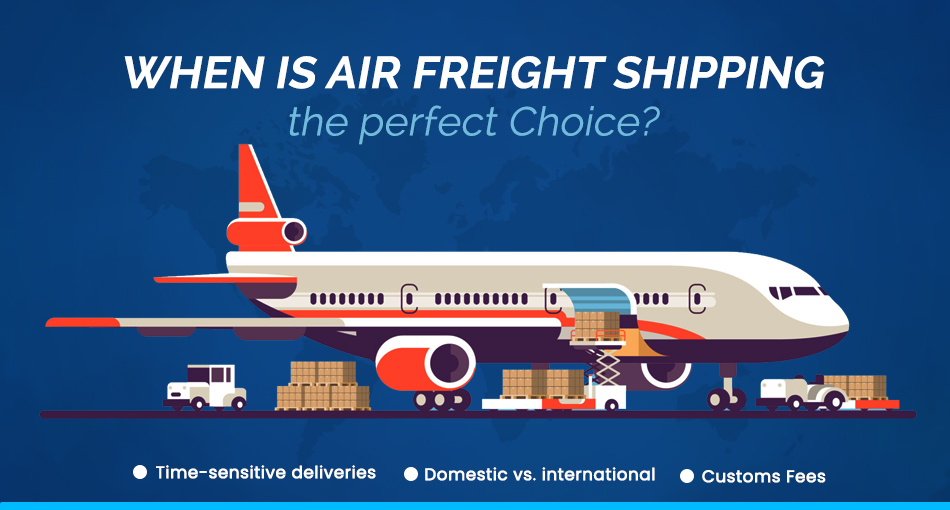
Domestic air freight vs international air freight
The flight process is similar, but international shipments add export and import paperwork, customs clearance in two countries and different cut-off times. Domestic moves skip customs and need less paperwork, yet air usually pays off only when the deadline is tight, because trucking is often cheaper over shorter distances. For ground options, see our domestic freight services. Faster Freight's air freight service focuses on shipments from the USA to airports worldwide.
Ship air freight from the USA with Faster Freight
Faster Freight is a Florida-based freight forwarder and a division of STG Freight Services, Inc., incorporated in 2005. We arrange standard and priority air freight from the USA, handle export documents, coordinate customs clearance and offer door-to-door delivery. One team manages the shipment.
Monday to Friday, 9am to 6pm ET. Learn more about our air freight forwarding services.
Air freight shipping FAQs
What is air freight shipping?
Air freight shipping is the transport of goods by aircraft, in the hold of passenger flights or on dedicated cargo planes. A freight forwarder books the space, prepares the paperwork and coordinates pickup, customs clearance and delivery. It is the fastest way to move goods between countries, but it costs more per kilo than ocean freight.
What is the difference between air freight and air cargo?
In everyday use there is no difference. Shippers, airlines and forwarders use air freight, air cargo, air shipping and airfreight interchangeably. Strictly speaking, air cargo usually means the goods being carried, while air freight usually means the service of moving them.
How long does air freight take?
The flight takes hours, but the full journey includes pickup, airline cut-offs, customs clearance and delivery. As a rule of thumb, international air freight often arrives within about a week door to door when paperwork is complete, compared with several weeks for ocean freight. We confirm an estimated schedule with every quote.
Is air freight expensive?
Air freight usually costs several times more per kilo than ocean freight, because aircraft space is limited and fuel is a large cost. It is priced by chargeable weight, the greater of actual and volumetric weight. For high-value or urgent goods, freight can be a small share of the total landed cost.
When is air freight better than ocean freight?
Choose air freight when a late delivery would cost more than the extra freight: urgent parts, high-value goods, perishables, product launches and small or lightweight shipments. Choose ocean freight for heavy, bulky or high-volume cargo with a flexible deadline.
What does air freight loading mean?
Loading is the stage where cargo is built up onto pallets or containers called unit load devices (ULDs) and loaded into the aircraft hold by the airline, a ground handler or a consolidator. It follows strict weight, balance and dangerous-goods rules, so cargo must reach the airline before its cut-off time.
How do I ship by air freight for the first time?
Give a forwarder your pickup and destination details, the number of pieces, their weights and dimensions, a description and value of the goods, and your target delivery date. The forwarder quotes, books the flight, prepares the air waybill and export filing, and coordinates customs and delivery. Tell them about batteries or other regulated items up front. You can request a quote online.